Blog
Beyond PLA: Why PETG is the “Goldilocks” of 3D Printing Materials
Dec
The Perfect Balance for Functional 3D Prints
If you have spent any time in the 3D printing community, your journey likely started with PLA. It’s cheap, easy to print, and comes in every color imaginable. However, as soon as you try to use a PLA part in a car on a hot day or for a mechanical tool, you quickly realize its limitations: it’s brittle and melts under pressure.
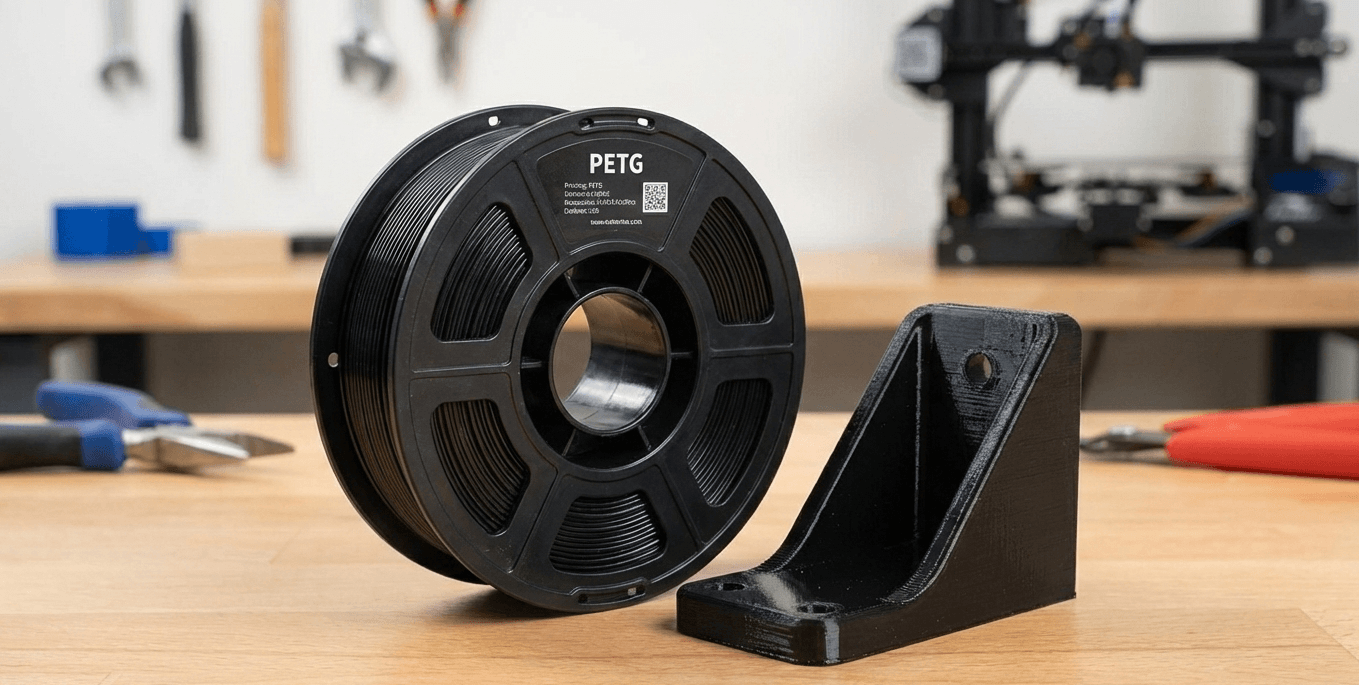
PETG (Polyethylene Terephthalate Glycol). Often called the “Goldilocks” of 3D printing materials, PETG sits comfortably between the user-friendliness of PLA and the high-strength performance of ABS. It isn’t just a compromise; for many functional applications, it is the superior choice.
Why PETG? The Top 3 Benefits for Real-World Use
- Impact Resistance & Durability: Unlike PLA, which tends to shatter when dropped or stressed, PETG has a degree of “flex” that allows it to absorb impacts. This makes it the go-to choice for drone parts, protective cases, and mechanical brackets.
- Thermal Stability: PLA begins to deform at around 55°C (131°F). PETG remains structurally sound up to approximately 80°C (176°F). This difference is critical for anything used outdoors or in environments with moderate heat.
- Chemical and UV Resistance: If you are printing items for the garden or a workshop, PETG is naturally more resistant to the elements and common chemicals compared to other standard filaments.
Comparison: PLA vs. PETG vs. ABS
| Feature | PLA | PETG | ABS |
| Ease of Use | Excellent | Good | Challenging |
| Durability | Low (Brittle) | High | Very High |
| Heat Resistance | Low | Medium | High |
| UV Resistance | Poor | Good | Poor |
| Odor | None | None | Strong/Toxic |
A Realistic Perspective: The Challenges of PETG
In the spirit of being realistic, PETG isn’t a “magic” filament. It requires a bit more tuning than PLA to get perfect results:
- The “Stringing” Issue: PETG is notorious for being “oozy.” Because it is more viscous, you will likely encounter fine, hair-like strings on your prints. This usually requires fine-tuning your retraction settings and travel speed.
- Hygroscopy (Moisture Absorption): PETG is like a sponge for humidity. If you leave it out in the open, it will absorb moisture from the air, leading to bubbles and poor surface finish. Investing in a dry box is almost mandatory for long-term PETG printing.
- Bed Adhesion (Too Much of a Good Thing): PETG sticks to glass so well that it can actually take a chunk of the glass with it when you try to remove the print. Using a release agent like hairspray or a PEI sheet is highly recommended.
Conclusion
PETG is the “Goldilocks” material because it offers the durability and heat resistance needed for professional-grade parts without the toxic fumes and warping headaches of ABS. While it requires a bit more maintenance and calibration, the jump in quality and utility for the end-user is undeniable.